
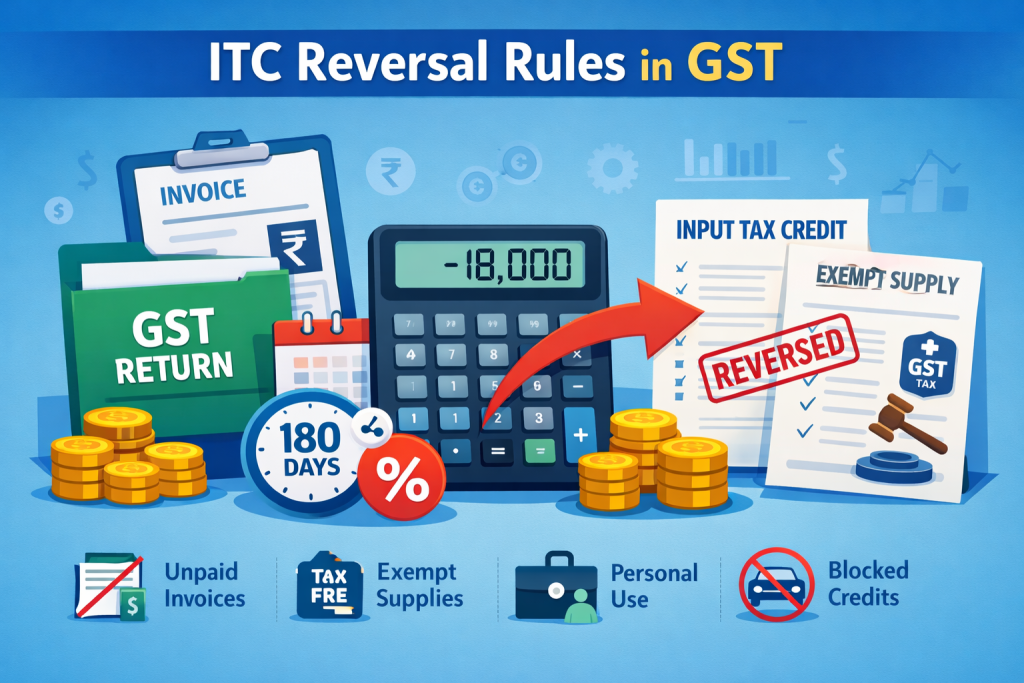
ITC Reversal Rules in GST – When & How? (With Practical Examples)
Introduction
Input Tax Credit (ITC) is one of the biggest benefits under GST, allowing taxpayers to reduce their tax liability. However, ITC is not unconditional. In certain situations, ITC reversal becomes mandatory as per the GST law.
This article explains when ITC reversal is required, how to calculate it, applicable GST rules, and real-life examples in a simple and practical manner.
What is ITC Reversal?
ITC Reversal means adding back the wrongly claimed or ineligible input tax credit to your output tax liability, along with interest where applicable.
Legal Provisions for ITC Reversal
ITC reversal is governed mainly by:
- Section 17(1) & 17(2) – Exempt & non-business supplies
- Section 17(5) – Blocked credits
- Rule 37 – Non-payment to supplier within 180 days
- Rule 42 & Rule 43 – Common ITC reversal
- Section 18(4) – ITC on switching to the composition scheme
- Section 29(5) – ITC reversal on cancellation of GST registration
When is ITC Reversal Required?
1. Non-Payment to Supplier within 180 Days
If payment (value + GST) is not made within 180 days from the invoice date.
🔹 Rule: Rule 37
🔹 Interest: 18% from the date of ITC availed
Example:
- ITC claimed: ₹18,000
- Supplier payment not made in 180 days
➡ ₹18,000 must be reversed
➡ Can be reclaimed after payment
2. Inputs Used for Exempt Supplies
If goods/services are used for taxable + exempt supplies, ITC must be reversed proportionately.
🔹 Rule: Section 17(2), Rule 42
Example:
- Total ITC: ₹50,000
- Exempt turnover: 40%
➡ ITC to reverse = ₹20,000
3. Personal or Non-Business Use
ITC related to personal use must be reversed.
🔹 Rule: Section 17(1)
Example:
- Mobile phone ITC: ₹3,600
- Personal use: 25%
➡ ITC reversal = ₹900
4. Blocked Credits (Section 17(5))
ITC is not allowed at all, hence it must be reversed if claimed by mistake.
❌ Motor vehicles (certain cases)
❌ Food & beverages
❌ Club membership
❌ Employee personal benefits
Example:
- ITC on hotel stay for director: ₹12,000
➡ Full reversal required
5. Switching to Composition Scheme
When a taxpayer opts for composition, ITC on:
- Stock
- Semi-finished goods
- Capital goods
must be reversed.
🔹 Rule: Section 18(4)
6. Cancellation of GST Registration
On cancellation, the remaining ITC must be reversed or paid.
🔹 Rule: Section 29(5)
How to Calculate ITC Reversal?
Step-by-Step Process
- Identify ineligible ITC
- Calculate proportionate reversal
- Add reversal amount to:
- GSTR-3B (Table 4B)
- Pay the applicable interest
Interest on ITC Reversal
| Situation | Interest |
|---|---|
| Wrongly availed & utilized | 18% |
| Non-payment within 180 days | 18% |
| Fraud / suppression | 24% |
Common ITC Reversal Mistakes
❌ Claiming ITC without supplier payment
❌ Not reversing exempt supply ITC
❌ Ignoring personal use
❌ Claiming blocked credits
❌ No annual adjustment under Rule 42/43
Best Practices to Avoid ITC Reversal
✅ Reconcile GSTR-2B monthly
✅ Track 180-day supplier payments
✅ Maintain separate expense records
✅ Perform year-end ITC review
✅ Use GST reconciliation software
Conclusion
ITC reversal is not a penalty, but a compliance correction mechanism under GST. Understanding when and how to reverse ITC helps businesses avoid interest, notices, and litigation.
Tip: Always review ITC eligibility before claiming to stay GST-compliant.
Disclaimer
This article is for educational purposes only and does not constitute professional advice. GST provisions are subject to change. Please consult a GST professional before taking any action.