
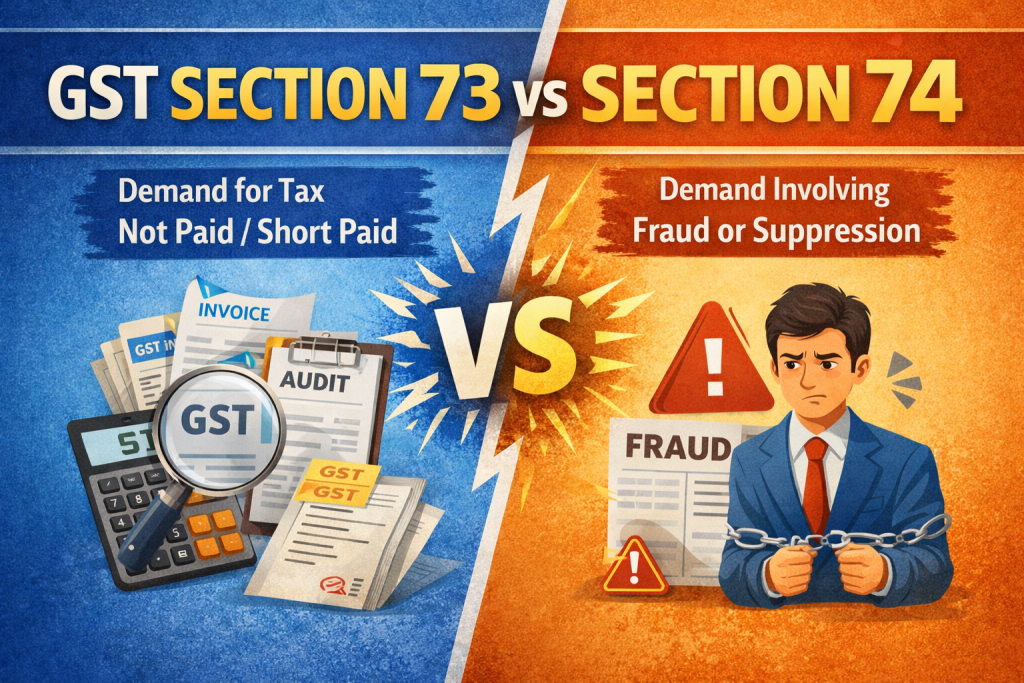
📘 GST Section 73 vs Section 74
Under the Central Goods and Services Tax Act, 2017, Sections 73 and 74 deal with demand and recovery of tax when GST is not paid or wrongly claimed.
🔹 Section 73 – No Fraud Cases
📌 When it applies:
- Tax not paid / short paid
- ITC wrongly claimed or utilized
- Refund wrongly taken
👉 WITHOUT fraud, wilful misstatement, or suppression of facts
⏱ Time Limit:
- Notice issued: within 3 years from due date of annual return
💰 Penalty:
- No penalty if tax + interest paid before notice
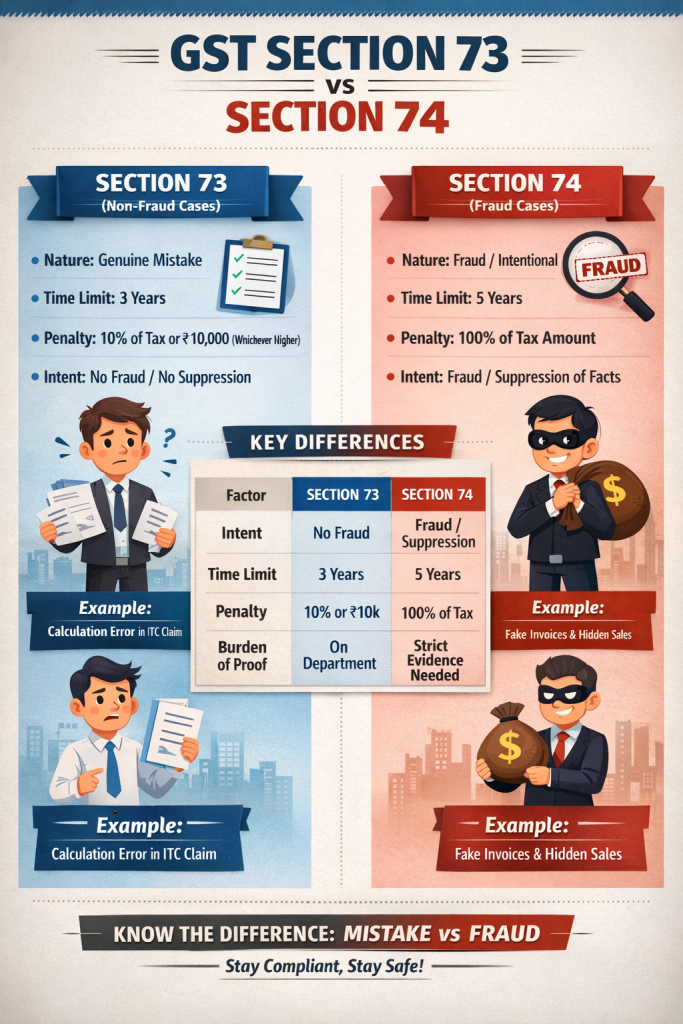
- Otherwise: 10% of tax or ₹10,000 (whichever higher)
📊 Example:
A trader mistakenly claims ₹50,000 extra ITC due to a calculation error.
- No intention to evade tax
- Department issues notice under Section 73
- Trader pays tax + interest → penalty may be avoided
🔴 Section 74 – Fraud Cases
📌 When it applies:
- Tax evasion with:
- Fraud
- Wilful misstatement
- Suppression of facts
⏱ Time Limit:
- Notice issued: within 5 years from due date of annual return
💰 Penalty:
- 100% of tax amount
- Reduced penalty if paid early:
- Before notice → 15%
- Within 30 days of notice → 25%
- Within 30 days of order → 50%
📊 Example:
A business intentionally hides ₹10 lakh sales to avoid GST.
- Clear intent to evade tax
- Case falls under Section 74
- Tax + interest + penalty (up to 100%) applicable
⚖️ Key Differences (Quick Table)
| Point | Section 73 | Section 74 |
|---|---|---|
| Nature | Genuine mistake | Fraud / Intentional |
| Time Limit | 3 years | 5 years |
| Penalty | 10% or ₹10,000 | 100% of tax |
| Intent | No fraud | Fraud involved |
📌 Important Legal Reference
- Section 73: Determination of tax not paid (non-fraud)
- Section 74: Determination of tax not paid (fraud cases)
💡 Practical Insight
- Most small businesses fall under Section 73
- Section 74 is used in serious tax evasion cases
- Proper bookkeeping helps avoid both
Part -II
Both sections are governed under the Central Goods and Services Tax Act, 2017 and deal with demand & recovery proceedings when tax is unpaid, short-paid, or ITC is wrongly claimed.
🔹 Section 73 – Determination of Tax (Non-Fraud Cases)
📌 Scope of Section 73
Applicable when:
- Tax not paid / short paid
- Refund wrongly taken
- ITC wrongly availed or utilized
👉 No fraud / no intention to evade tax
🧾 Legal Process (Step-by-Step)
1. 📢 Pre-Notice (DRC-01A)
- Officer may issue intimation before notice
- Taxpayer can voluntarily pay
2. 📩 Show Cause Notice (SCN – DRC-01)
- Issued when tax is still unpaid
- Specifies:
- Tax amount
- Interest
- Proposed penalty
3. 💬 Reply by Taxpayer
- Submit explanation with documents
- Opportunity of being heard (natural justice)
4. 📜 Order (DRC-07)
- Final order issued after considering reply
⏱ Time Limits
- SCN: 3 years from due date of annual return
- Order: within 3 years + 3 months
💰 Penalty Structure
| Situation | Penalty |
|---|---|
| Paid before SCN | ❌ No penalty |
| Paid within 30 days of SCN | ❌ No penalty |
| After order | ✅ 10% of tax or ₹10,000 |
📊 Practical Example
A business forgets to include one invoice of ₹2 lakh in GSTR-1.
- GST short paid: ₹36,000
- No fraud → Section 73 applies
- Pays tax + interest after notice → no penalty
🔴 Section 74 – Determination of Tax (Fraud Cases)
📌 Scope of Section 74
Applicable when there is:
- Fraud
- Wilful misstatement
- Suppression of facts
👉 Intent to evade tax is key
🧾 Legal Process (More Strict)
Same structure as Section 73, but stricter:
1. 📢 Pre-Notice (DRC-01A)
- Optional but often issued
2. 📩 Show Cause Notice (SCN – DRC-01)
- Clearly mentions fraud allegations
3. 💬 Reply & Hearing
- Taxpayer must justify actions
- Heavy scrutiny
4. 📜 Order (DRC-07)
- Final demand with penalty
⏱ Time Limits
- SCN: 5 years from due date of annual return
- Order: within 5 years + 6 months
💰 Penalty Structure (Very Important)
| Payment Timing | Penalty |
|---|---|
| Before SCN | 15% |
| Within 30 days of SCN | 25% |
| Within 30 days of order | 50% |
| After that | 100% |
📊 Practical Example
A company deliberately:
- Shows fake purchases
- Claims ₹5 lakh fake ITC
👉 विभाग detects fraud
- Section 74 applied
- Tax + interest + penalty (up to ₹5 lakh)
⚖️ Core Legal Difference (Conceptual Understanding)
| Factor | Section 73 | Section 74 |
|---|---|---|
| Intent | No intention | Intentional fraud |
| Nature | Civil liability | Quasi-criminal |
| Burden of Proof | On department | Strong evidence needed |
| Penalty Severity | Low | Very high |
🔍 Important Concepts You Must Cover in Blog
1. 🧠 “Suppression of Facts”
- Not just hiding data
- Includes non-disclosure affecting tax liability
2. ⚠️ “Wilful Misstatement”
- Providing wrong information knowingly
3. 💡 “Fraud Indicators”
- Fake invoices
- Circular trading
- Bogus ITC
- Undisclosed turnover
📑 Important Forms Used
| Form | Purpose |
|---|---|
| DRC-01A | Pre-notice intimation |
| DRC-01 | Show cause notice |
| DRC-03 | Voluntary payment |
| DRC-07 | Final order |
| DRC-06 | Reply to SCN |
🔄 Voluntary Payment Option
Before notice:
- Pay via DRC-03
- Inform department
👉 Helps avoid litigation & penalty
⚖️ Landmark Practical Interpretation
- Clerical mistakes → Section 73
- Fake billing → Section 74
- Mismatch in returns → Usually 73 (unless fraud proven)
🔗 Useful Reference Links
- 🌐 Official GST Portal
👉 https://www.gst.gov.in - 📘 CBIC GST Law (Bare Act)
👉 https://cbic-gst.gov.in - 📚 Detailed Professional Article
👉 https://taxguru.in/goods-and-service-tax/difference-between-section-73-and-74-gst.html
💡 Expert Insight (Very Useful for Blog Authority)
- The department often initially invokes Section 74, later converted to 73 if fraud is not proven
- Proper documentation is the strongest defence
- Early payment reduces heavy penalties